Brexit. A global pandemic. Inflation. Rising interest rates. Wars disrupting global markets. In the space of just ten years, the United Kingdom has also seen seven Prime Ministers, each bringing new economic priorities, housing policies and political uncertainty.
For many property markets, that would be enough to derail growth. While headlines have changed with remarkable frequency, one thing has remained surprisingly consistent: Manchester has quietly delivered the strongest house price growth of any major UK city over the past decade. Political administrations have come and gone, financial markets have fluctuated, and global events have repeatedly tested investor confidence. Yet Manchester’s property market has continued to move forward.
When the long-running Halifax House Price Index—one of Britain’s most respected housing benchmarks since 1983—was officially relaunched as the Lloyds House Price Index this July, the latest figures reinforced exactly that story. While many southern markets continue adjusting to higher borrowing costs and economic uncertainty, Manchester remains one of Britain’s strongest-performing cities, supported by the structural factors that matter most.
Strong Fundamentals Trump Political Cycles
The biggest mistake investors can make is confusing political noise with market fundamentals. Governments change. Policies evolve. Budgets are rewritten. Yet people still need somewhere to live, businesses still need talented workers, and growing cities still require more housing.
Manchester’s transformation over the past three decades demonstrates this perfectly. Once known primarily for its industrial heritage, the city has evolved into one of the UK’s leading centres for finance, technology, advanced manufacturing, life sciences, media and professional services. Global businesses continue to expand their presence in the city, attracted by a highly skilled workforce, world-class universities, competitive operating costs and excellent transport connectivity.
The result is a powerful economic cycle. Businesses create jobs. Jobs attract people. Growing populations increase housing demand. When supply struggles to keep pace, property values tend to rise over the long term. That cycle has remained remarkably resilient despite repeated economic and political disruptions.
Leadership with a Long-Term Vision
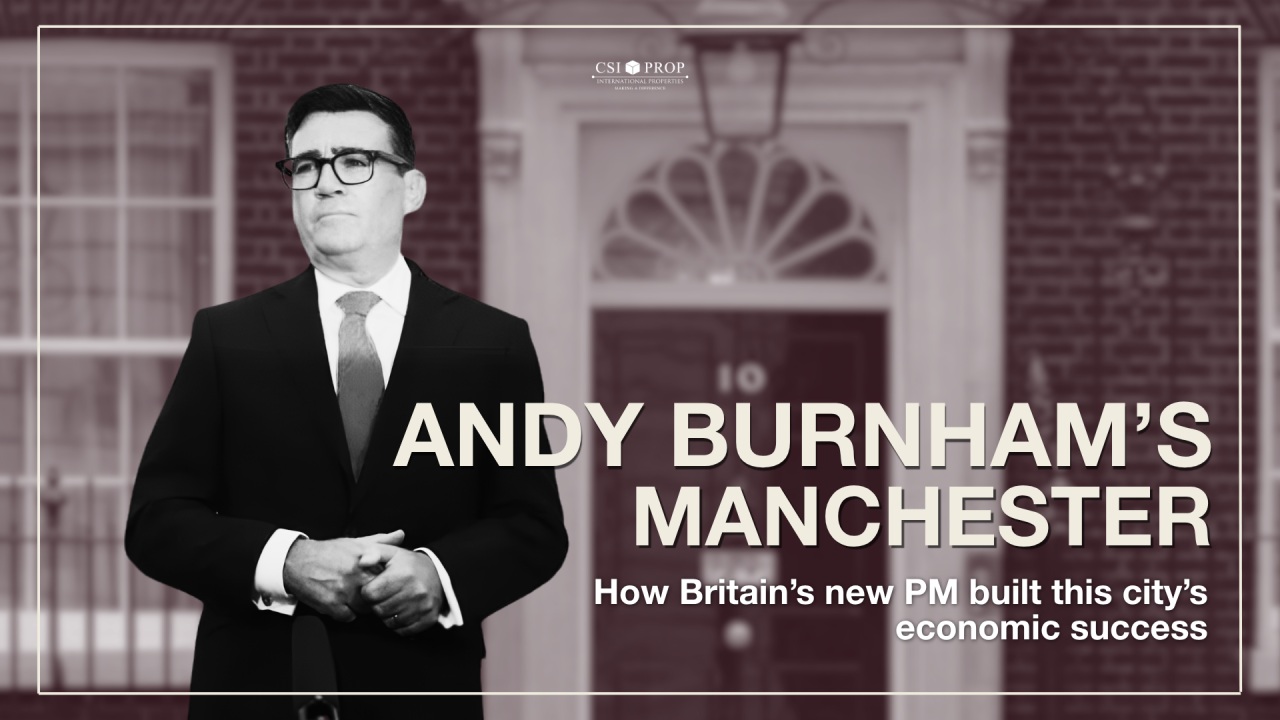
Manchester’s success has not happened by chance. Under the leadership of Greater Manchester Mayor Andy Burnham, the region has continued to pursue an ambitious long-term growth strategy focused on regeneration, transport investment, housing delivery and greater regional autonomy through devolution. While no single political leader can solve Britain’s housing shortage overnight, Manchester has maintained a relatively consistent vision for economic development, even as governments in Westminster have changed repeatedly. For investors, that consistency matters.
Rather than relying on short-term political announcements, Manchester has continued investing in the infrastructure and economic foundations that make cities attractive places to live, work and build businesses. Strong leadership cannot eliminate market cycles, but it can help create the conditions that encourage sustained long-term growth.
Britain’s Best-Performing Major City
Manchester’s economic success has translated into one of the UK’s most compelling property stories. Over the past decade, average asking prices across Greater Manchester have increased by approximately 63%, rising from around £160,000 to more than £260,000. By comparison, London’s average asking prices increased by just 7% over the same period.
The latest Lloyds House Price Index tells a similar story. While many of the UK’s more expensive southern markets have softened under higher interest rates and economic uncertainty, the North West recorded annual house price growth of 2.4%, outperforming much of southern England. London, meanwhile, experienced a year-on-year decline in average property values.
For investors, this highlights an important advantage. Manchester continues to offer a significantly lower entry price than many southern markets while still benefiting from strong underlying demand and long-term capital growth potential.
The Housing Shortage Isn’t Going Away
The real story behind Manchester’s resilience is not politics. It is supply and demand. The UK continues to face a well-documented housing shortage, and Manchester is no exception. The city’s growing economy continues attracting new residents faster than homes can be delivered. Successive governments have introduced different housing strategies, planning reforms and policy initiatives, yet the underlying imbalance between supply and demand remains.
A Population That Keeps Growing
Population growth remains one of the strongest indicators of future housing demand, and Manchester continues to move in the right direction. Between 2011 and 2021, the city’s population increased by almost 10%, with adults aged between 20 and 24 representing its largest demographic. Manchester is also home to around 70,000 university students across several globally recognised institutions. Many choose to remain after graduation, building careers in the city’s growing financial, legal, technology and creative sectors.
For property investors, this creates something every successful housing market depends upon: a consistent pipeline of future tenants, skilled professionals and first-time homebuyers.
A City People Want to Call Home
Changing lifestyles have strengthened Manchester’s appeal as one of Britain’s most desirable urban destinations. Flexible and hybrid working have fundamentally changed where many professionals choose to live, shifting the focus away from proximity to a London office towards affordability, career opportunities, connectivity and quality of life. Manchester delivers on all fronts, offering the energy and opportunities of a major international city without London’s premium price tag.
From its globally recognised football clubs and legendary music scene to award-winning restaurants, independent cafés and vibrant creative districts, the city offers an attractive balance between career and lifestyle. Its compact, walkable city centre further enhances its appeal, allowing residents to live, work and socialise with ease, while its expanding economy continues to attract young professionals, entrepreneurs and families from across the UK and overseas.
Manchester’s growing reputation has also earned international recognition. The Economist Intelligence Unit’s Global Liveability Index ranked it as the highest-ranked city in the United Kingdom, placing 52nd globally ahead of both London and Edinburgh. Assessing factors such as stability, healthcare, education, infrastructure and culture, the ranking reinforces Manchester’s ability to attract businesses, skilled professionals and international talent. Increasingly, Manchester is no longer simply a place people move to for work—it is a city people actively choose to call home, supporting resilient long-term demand for housing.
The Bottom Line
The past decade has tested property markets in every conceivable way—from Brexit and COVID-19 to inflation, rising interest rates and seven Prime Ministers. Yet Manchester has continued to outperform, driven not by political cycles but by enduring fundamentals: a growing economy, rising population and persistent housing demand.
No market is immune to short-term volatility. But Manchester has demonstrated something far more valuable—resilience. For long-term investors, that’s what makes it one of the UK’s most compelling property markets.