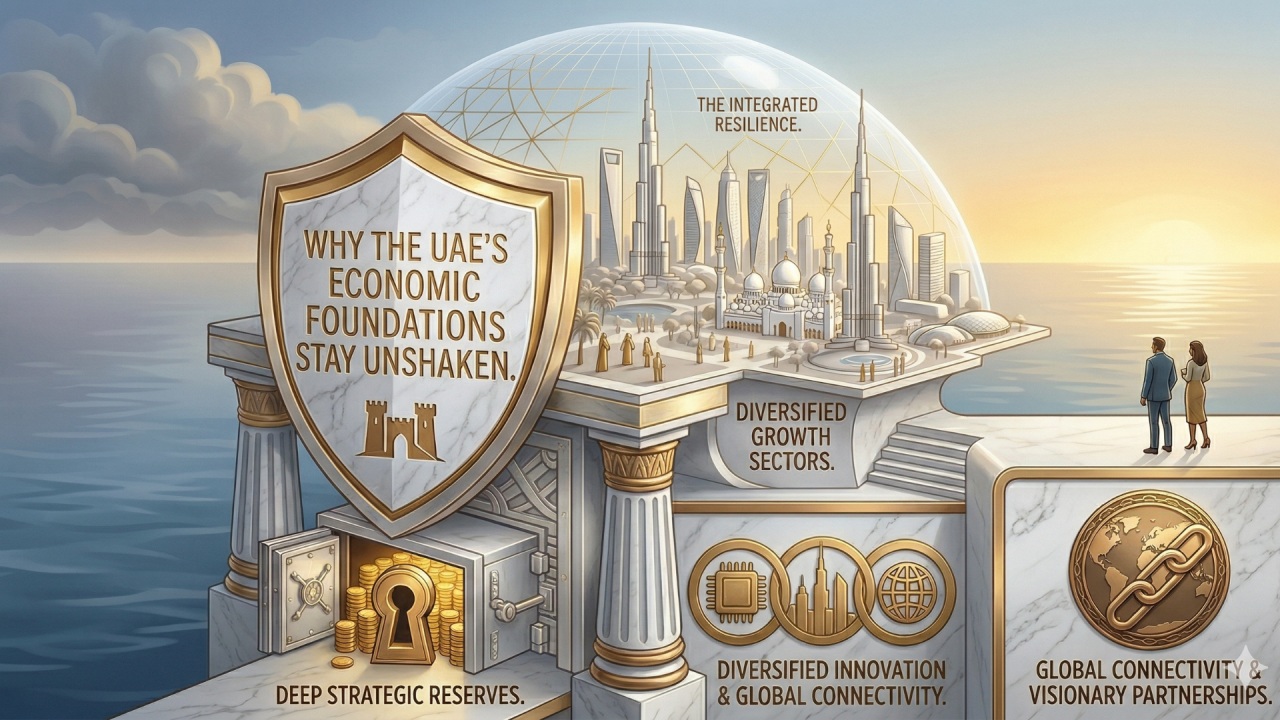
It has been one month since the escalation of regional tensions began. For any property owner or investor, the headlines of the past thirty days have naturally brought a sense of weight. Beyond the immediate noise, however, lies a story of a nation that has spent decades preparing for this exact moment — a nation whose “People First” philosophy is fortified by some of the most sophisticated defense and economic architectures in the world.
A Shield Proven Under Fire
The first concern for any investor is the safety of their home and family. In the past month, the UAE’s “Integrated Shield” has transitioned from a theoretical deterrent to a proven success. Recording a 94% interception rate for ballistic missiles and a 95% rate for drones, the Ministry of Defense successfully neutralized over 2,000 threats as of end March.
Professor Abdulkhaleq Abdulla, a leading Gulf Affairs and Security expert and author, recently noted that the UAE has defended its skies with an elite success rate. The fact that major hubs like the DIFC have reported zero injuries despite being targeted is a testament to the “interception shield” that physically protects your assets and your peace of mind.
The Great Divergence: Why Property Outperforms Stocks
One of the most persistent misunderstandings in the current climate is the conflation of developer stock prices with the value of physical property. In early March, the Dubai Financial Market Real Estate Index shed 20% of its value in under two weeks. To a casual observer, it looked like a crash.
But here is the data point the headlines missed: in that very same week, Dubai recorded 3,570 actual property transactions worth AED 11.93 billion. While the stock index was plunging due to algorithmic “risk-off” selling, real assets were changing hands for real dirhams. Property remains more resilient than stocks because it is a fundamental-driven asset; it doesn’t reprice based on a panic-post, but on the structural need for housing in a city that just crossed the 4-million population mark.
Operational Resilience: A “Business as Usual” Mandate
If the market were truly in retreat, the builders would be the first to signal a slowdown. Instead, the UAE’s institutional leaders have confirmed that construction and operations are progressing as usual. Explosive 2026 Momentum: The first two months of 2026 saw UAE property sales reach AED 17.2 billion, a 118% increase compared to the same period in 2025.
- The Record Backlogs: Leaders like Emaar and Aldar posted record-high backlogs in their FY2025 results (with Emaar holding AED 155 billion). These developers are not in a state of pause; they are in a state of execution, with billions in committed revenue that they must deliver.
The Legal Fortress: Accountability for Both Sides
A common question during regional instability is whether “Force Majeure” can be invoked to cancel contracts. Under Article 273 of the UAE Civil Code, Force Majeure is extremely difficult to invoke. The law requires an event to render performance absolutely impossible, not just commercially inconvenient.
Critically, this legal bar cuts both ways. While buyers are expected to maintain their payment schedules, developers are held to the same high standard. They cannot easily delay delivery or invoke regional noise as an excuse for non-performance. Because construction is moving at full speed, both parties remain bound to their SPAs. For the investor, this ensures that the developer remains as committed to completing the building as you are to owning it.
The “Safety Floor”: Abu Dhabi’s Scarcity Play
For investors seeking a “safe harbor” risk profile, the UAE offers a unique internal hedge: the Abu Dhabi Safety Floor. This is a mathematical reality driven by extreme scarcity. While Dubai and Abu Dhabi share populations of roughly 4 million, Dubai has over 120,000 units in development, whereas Abu Dhabi has only 6,000. This creates a structural price support that the noise of conflict cannot break. Even mid-conflict, developer launches in Abu Dhabi, such as those by Modon, continue to sell out instantly because the end-user demand is permanent.
De-Risking Through Time: The 3-Year Horizon
The smartest move in the current climate is to buy into the future. By selecting properties with completion dates 1-3 years down the road such as the Muheira project, you effectively de-risk your entry.
Real estate is a patient asset. One thing is certain: by the time these properties complete in 2027 or 2029, the global landscape will look very different. Historically, these tensions settle into a new baseline of stability; if they do not, the global implications would render property concerns secondary to much larger issues. By choosing longer-dated completions, you allow your investment to “wait out” the current noise, supported by ring-fenced escrow accounts and the UAE’s S&P AA-rated fiscal strength.
The CSI Perspective
As investor-practitioners ourselves, our practice during crises is always distilled into a solid three-pronged approach:
1. Read between the (head)lines: Remove Emotion + Monitor Facts : Removing sentiment from fundamentals has always been our approach because the property market does not reprice at the same speed as emotion. Focus on strategy and gain the advantage of identifying the “gap” between emotional reactions and actual changes in market conditions. Monitor real-time signals like transaction volumes, pricing and mortgage activity. The UAE property transactional market is transparent with transactions openly published on websites like https://dxbinteract.com/.
2. Leverage Pattern Recognition : In a dynamic market like the UAE, pattern recognition is an investor’s greatest asset. Identifying historical cycles replaces the fear of uncertainty with a sense of familiarity. Historically, UAE property prices have always rebounded strongly after geopolitical tensions thanks to robust underlying fundamentals. Recognizing these patterns allows you to separate short-term noise from long-term value, positioning yourself strategically while others are busy reacting to the news.
3. Prioritize Prime Assets & Global Diversification : High-quality assets characterized by scarcity and proven end-user demand historically retains its value better during market shifts. Avoid settling for subpar “deals.” Remember, a resilient portfolio requires balance, making it critical to diversify across other global markets.
Get a guided perspective of property investment based on our GOLDMINE and SAFETY 1st criteria. Reach out to us directly and speak to our team today.