There is a slightly unfair problem with writing about the UAE: by the time you finish explaining what it has already built, it has announced something even bigger.
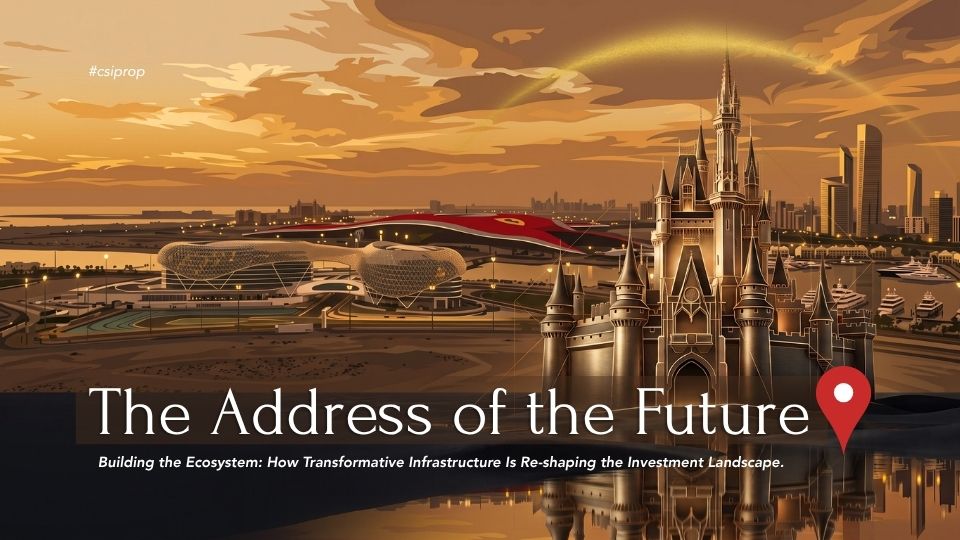
Burj Khalifa? Done. Palm Jumeirah? Done. Louvre Abu Dhabi? Done. Ferrari World? Done. So what comes next? A 260-million-passenger airport, Disneyland Abu Dhabi, the world’s largest Guggenheim, new metro lines, massive waterfront destinations and entire communities built around forests and lifestyle.
This is no longer simply a story about spectacular landmarks. It is a story about a country deliberately building the infrastructure, attractions and economic ecosystem to support its next phase of growth. And for property investors, that matters.
The UAE Is Building for What Comes Next
Dubai’s next chapter is being shaped by infrastructure on an extraordinary scale.
Al Maktoum International Airport is planned to eventually handle 260 million passengers a year — five times the capacity of Dubai International Airport. To put that into perspective, that is enough annual capacity to move more than seven times the population of Canada through one airport. Around it, Dubai South is being developed into a new residential and commercial hub. The Dubai Metro Blue Line is expected to serve around one million people, while further transport projects will connect more parts of the city.
Why does this matter to property?
Because infrastructure creates accessibility, and accessibility creates demand. Airports bring businesses and jobs. Transport makes new neighbourhoods easier to reach. Businesses bring employees. Employees need homes.
Dubai’s ambition isn’t limited to infrastructure. The city is still building landmarks — but increasingly, it is building entire destinations around them.
Burj Azizi is planned to rise approximately 725 metres, making it the world’s second-tallest building and combining luxury residences, hospitality, retail and entertainment. Dubai Creek Tower is being redesigned as a future landmark at Dubai Creek Harbour, while nearby Dubai Square is planned as a vast 7.4-million-square-metre mixed-use destination with around 10,000 homes, hotels, retail and leisure facilities. Then there is Ghaf Woods, where 35,000 trees are planned across a forest-living community — a reminder that Dubai’s definition of luxury is evolving beyond the skyline to include nature, wellness and lifestyle.
These are not isolated buildings. They are destinations designed to attract residents, visitors, businesses and investment. The more complete the ecosystem becomes, the stronger the reasons for people to live, work and spend time there.
Abu Dhabi Is Following a Similar Formula
Abu Dhabi is taking a different route, building its identity around culture, entertainment, luxury and waterfront living. Saadiyat Island is evolving into a global cultural destination, with the Guggenheim Abu Dhabi, expected to open in late 2026, joining Louvre Abu Dhabi, Zayed National Museum and other major institutions.
Then comes the entertainment heavyweight: Disneyland Abu Dhabi.
Planned for Yas Island, Disney’s first theme park in the Middle East will join Ferrari World and Warner Bros. World, while Sphere Abu Dhabi and other major attractions are also in the pipeline. There had been some uncertainty over whether major international events and projects would continue as planned amid the region’s recent geopolitical tensions. The confirmation that Abu Dhabi will host the Formula 1 season finale puts some of that uncertainty to rest — and sends another strong signal of confidence in the capital.
Connectivity is also expanding. Etihad Rail’s passenger service is expected to begin in 2026, connecting 11 cities and regions across the UAE and eventually carrying up to 36.5 million passengers annually. That’s roughly 100,000 passengers every day. Again, the number is impressive. But the bigger story is what connectivity enables: people can live further from where they work, businesses can access a wider talent pool, and previously less-connected areas can become increasingly attractive places to live and invest.
And Property Is Already Responding
Aldar’s launch of The Canopies at Yas Point generated AED 1.5 billion in sales, demonstrating strong investor appetite for property within an increasingly sophisticated Yas Island ecosystem. Across Abu Dhabi’s wider residential market, the ValuStrat Price Index (VPI) for freehold properties reached 151.1 points in Q2 2026, up from its baseline of 100 points in Q1 2021. In simple terms, this means freehold residential property prices have risen by 51.1% in just over five years. And the momentum is still building, with prices increasing 2.1% quarter-on-quarter and 17.8% year-on-year.
A nearly 18% annual increase is difficult to ignore. It suggests investors are not waiting for every airport, museum, theme park and transport network to be completed before recognising the opportunity. They are already positioning themselves as the UAE builds towards its next phase of growth.
The Bigger Opportunity
Perhaps the most compelling thing about the UAE is not what it has already achieved, but what it is positioning itself to become. Tourism, aviation, technology, culture, logistics, finance and entertainment are being woven into an economy designed to attract global capital and talent for decades to come.
Sheikh Mohammed bin Rashid Al Maktoum (Prime Minister of UAE) has spoken of Dubai’s aspiration to become the best city in the world to live, work and visit. At the same time, Dubai and Abu Dhabi are pursuing ambitions to strengthen their positions among the world’s leading financial centres, with plans to rank among the world’s top four and top five financial hubs respectively.
Ambitious? Absolutely. But the UAE has built a reputation for setting targets that may initially sound extraordinary — and then getting to work on making them happen. Think about Singapore. Think about Hong Kong. Their rise into global financial and business hubs created enormous opportunities for those who recognised their trajectory early. By the time the rest of the world agreed they had arrived, much of the early opportunity had already been captured.
The UAE is, of course, writing its own story. But if you missed the rise of Singapore or Hong Kong, this may be one opportunity you do not want to watch from the sidelines. The UAE isn’t simply building more buildings. It is building towards becoming one of the world’s great cities and financial centres. And if history has taught investors anything, it is that by the time everyone agrees the future has arrived, the best opportunities may already be behind them.